
How a 25-year-old Bihari native impressed his bosses in the dreaded Lashkar-e-Tayiba.
What made the Mumbai 26/11 attacks so deadly in nature? First and foremost, it was the ploy of the Lashkar-e-Tayiba and secondly it was perfect planning thanks to the near-perfect logistical support that had been provided to terrorists who finally entered into India's business capital and went on a rampage.
The ISI had forged ties with jihadi groups throughout the 1980s when the CIA used it to support the Mujahideen against the Soviet Army in Afghanistan and when it saw an opportunity in 1989 to weaken India by creating trouble in Jammu and Kashmir, the outfit's terrorists were infiltrated into India, the newspaper reported.
Senior Superintendent of Police, Baramulla, Vijay Kumar said the police raided Sopore on specific information and arrested LeT militant Nisar Ahmad Dar alias Sajid.

External Affairs Minister S Jaishankar discusses India's approach to cross-border terrorism following the Pahalgam attack, emphasizing a firm response and no compromise on nuclear blackmail.
Joint Commissioner of Ahmedabad Police C P Pandey made this claim on the first anniversary of the attack.

Tahawwur Hussain Rana, a Canadian national convicted in the United States for his role in the 2008 Mumbai terror attacks, has been extradited to India. Rana, a close associate of Pakistani-American terrorist David Coleman Headley, was involved in the conspiracy from 2005 onwards and assisted Headley in obtaining a visa for India. He is the third person to be sent on trial in India for the 26/11 attacks after Ajmal Kasab and Zabiuddin Ansari alias Abu Jundal. Rana's extradition comes after US President Donald Trump approved the request.
Police is interrogating the duo to find out about the terrorist outfit's activities in Mumbai.
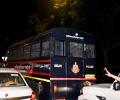
Tahawwur Hussain Rana, a key figure in the 2008 Mumbai terror attacks, has been extradited from the US to India and produced before a Delhi court. Rana, a close associate of David Coleman Headley, was brought to India after the US Supreme Court dismissed his review plea against extradition. The National Investigation Agency (NIA) has sought 20 days of custody to interrogate Rana, citing clinching evidence, including emails. The agency believes that Rana's interrogation is critical to understanding the larger conspiracy behind the attacks and his role in planning them.

This came after Pakistan People's Party chairman Bilawal Bhutto Zardari on Saturday stated that Pakistan's Prime Minister Shehbaz Sharif had tasked him to lead a delegation to present Pakistan's case on the recent escalations of tensions between the two nations.
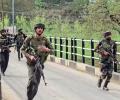
"More than 85,000 domiciles have been issued to non-locals, creating a pathway for demographic change in Jammu & Kashmir. These non-locals arrive posing as tourists, obtain domiciles, and then begin to act as if they own the land. Consequently, violence will be directed toward those attempting to settle illegally," TRF said in a statement which could not be independently verified by Rediff.

The accused PFI leaders also conspired to establish Islamic rule in India by committing terrorist acts as a part of violent jihad, as per the report.
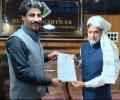
A court in New Delhi on Tuesday granted two-hour custody parole to Kashmiri leader Sheikh Abdul Rashid to take oath as a Lok Sabha MP on July 5.

This was the first encounter between terrorists and security forces in Jammu and Kashmir in more than three months.

The National Investigation Agency has picked a key Lashkar-e-Tayiba operative who was allegedly planning the assassination of prominent Hindu leaders. Known as the Bangalore assassination plot, the case made headlines when several persons were picked up allegedly for plotting the assassination of pro-Hindu journalists and other leaders.

The central government has appointed advocate Narender Mann as special public prosecutor to conduct trials and other matters related to the National Investigation Agency case RC-04/2009/NIA/DLI against Tahawwur Hussain Rana and David Coleman Headley, who is in a US prison following a plea deal.

Two men the Jammu and Kashmir police described as Lashkar-e-Tayiba terrorists were killed in an encounter in Rainawari, Srinagar.

The operation to neutralise the terrorists involved in the encounter that led to the killing of four security forces personnel continued for the second day on Thursday, September 14, 2023.

The attack, which took place near a heavily guarded complex housing All India Radio and Doordarshan Kendra near the Tourist Reception Centre, comes a day after security forces eliminated a top Pakistani commander of Lashkar-e-Tayiba in the Khanyar locality of downtown Srinagar.
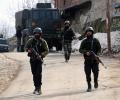
A Lashkar-e-Toiba militant involved in the killing of a carpenter from Uttar Pradesh's Saharanpur recently was among two terrorists killed, while three security personnel were injured in an encounter in Shopian district of Jammu and Kashmir on Wednesday, officials said.

According to a notification issued by the ministry, the JKGF has been involved in infiltration bids, narcotics and weapon smuggling, terror attacks in the Union territory, and threats to security forces.
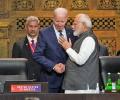
Pakistan has formally lodged a protest with the US over its joint statement with India against the country's involvement in cross-border terrorism.
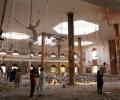
The Bahawalpur centre is notorious for hoarding arms and ammunition left behind by the NATO forces in Afghanistan, the officials said.
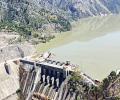
Pakistan has halted the construction of contentious canals in Punjab province after India suspended the Indus Waters Treaty following a deadly terrorist attack in Kashmir. The decision to suspend the canals project was made after Prime Minister Shehbaz Sharif met with PPP chairman Bilawal Bhutto-Zardari and agreed to address the concerns of Sindh province, where the project had sparked protests. The canals project, aimed at irrigating the desert region in Punjab, was seen as a threat to water resources in Sindh. Both sides have agreed to seek consensus on the issue in the Council of Common Interests (CCI), a high-powered inter-provincial body. Meanwhile, Pakistan has reiterated the importance of the Indus Water Treaty for its water security and economy, and condemned India's move to suspend it.

Three Jaish-e-Mohammed militants were killed in the Drach area of Shopian, while a Lashkar-e-Tayiba militant was killed in the Moolu area of the south Kashmir district, the police said.
'It could be the Pakistan army's commercial interest, tactical or strategic interest or one of their leaders.' 'Even if you send a message that we have attempted to kill one of the Pakistani generals, that itself will serve the purpose.'
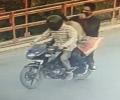
Two locals were also identified by the police and are believed to be from one of the villages in south Kashmir. Police were trying to corroborate the evidence from the ground, they said.
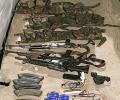
Security agencies have gathered evidence, including Pakistani government documents and biometric data, confirming that the terrorists involved in the Pahalgam attack were Pakistani nationals.

The operation to neutralise the terrorists involved in the encounter that led to the killing of four security forces personnel continued for the second day on Thursday as the police claimed to have "encircled" two Lashkar-e-Tayiba terrorists in the higher reaches of Anantnag district of south Kashmir.

Three Lashkar-e-Tayiba terrorists were killed in an encounter with security forces in Shopian district of Jammu and Kashmir on Tuesday, the police said.

The officials said Usman, who was well familiar with the Valley terrain, was a significant figure in orchestrating numerous terror attacks since his initial activity in the early 2000s.

The highlight of Tuesday's debate on Operation Sindoor was the speech by Prime Minister Narendra Modi, with the rebuttal by Congress's Wayanad MP Priyanka Gandhi coming a close second.

According to intelligence reports, the terrorists entered the Akhnoor region through the Battal area, and a wireless set seized from them confirmed their association with the JeM.

It was alleged that he had planned the terror attack and helped Lashkar-e-Tayiba in carrying it out.
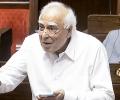
Rajya Sabha MP Kapil Sibal has congratulated both the previous UPA government and the current dispensation for the extradition of Tahawwur Hussain Rana, the mastermind behind the 2008 Mumbai attacks. Sibal expressed confidence that the extradition will shed light on the involvement of individuals within Pakistan's establishment in the attacks. Rana is being questioned by the National Investigation Agency (NIA) to uncover the full extent of the conspiracy behind the deadly 2008 terror strikes. Sibal highlighted the efforts of the UPA government in establishing the NIA and pursuing Rana's extradition, and also acknowledged the current government's success in bringing him back to India. The interrogation is expected to focus on Rana's potential ties to the Lashkar-e-Taiba (LeT) and his role in the Mumbai attacks.
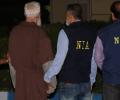
Tahawwur Hussain Rana, a Canadian national accused of involvement in the 2008 Mumbai terror attacks, has been extradited to India from the United States. Rana's interrogation is expected to shed light on the role of Pakistani state actors in the attacks, which claimed 166 lives. Indian authorities are particularly interested in his travels across India in the days leading up to the attacks, including visits to Hapur, Agra, Delhi, Kochi, Ahmedabad, and Mumbai. Rana's extradition follows a lengthy legal battle, with the US Supreme Court ultimately denying his application to challenge it. Rana is known to be associated with Pakistani-American terrorist David Coleman Headley, one of the main conspirators of the 26/11 attacks. The investigation into the Mumbai attacks has implicated senior members of terror outfits Lashkar-e-Taiba (LeT) and Harkat-ul Jihadi Islami (HuJI), as well as officials from Pakistan's Inter-Services Intelligence (ISI).

The Delhi prisons department has written to a city court to issue a death warrant against the guilty in the 2000 Red Fort attack case, officials said on Monday.
A letter by a LeT commander threatened to blow up the Saharanpur and Hapur railway stations and other stations as well.
Tahawwur Rana, a Canadian citizen and native of Pakistan, was extradited to India to face charges related to his alleged role in the 2008 Mumbai terror attacks. The US Department of Justice said Rana allegedly commended the LeT terrorists who carried out the attacks and suggested they should be awarded Pakistan's highest gallantry award. Rana is accused of facilitating a fraudulent cover for his childhood friend, David Headley, to conduct surveillance in Mumbai for the Lashkar-e-Taiba (LeT) terrorist group. He is also accused of helping Headley submit false visa applications to Indian authorities. This extradition follows a lengthy legal process that began in 2020 with India's request for Rana's surrender. Rana, who was previously convicted in the US for providing material support to LeT, will now face trial in India on 10 criminal charges related to the Mumbai attacks.
